 FREE shipping on orders over US$200
What Is CPO?
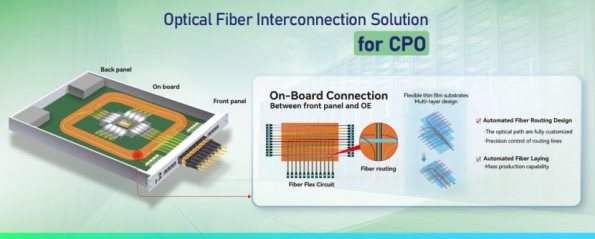
CPO stands for Co-Packaged Optics. It refers to an integration approach where optical engines are packaged close to high-speed electronic chips, such as switch ASICs, network processors, or AI accelerators. The goal is to reduce the distance that high-speed electrical signals must travel before being converted into optical signals.
In a traditional data center switch, pluggable optical transceivers are inserted into the front panel. Electrical signals must travel from the switch ASIC across the printed circuit board to the module cage. At very high data rates, this electrical path causes loss, distortion, and higher power consumption. CPO reduces this problem by moving optical conversion much closer to the ASIC.
In simple terms, CPO brings the optics closer to the chip. Shorter electrical paths reduce signal loss, while optical fiber handles longer-distance, high-capacity transmission more efficiently.
| Plain-language definition: CPO integrates optical engines near the switch or computing chip so data can be converted from electrical signals to optical signals with less power loss and higher bandwidth density. |
Why AI Data Centers Need CPO
AI data centers are built around large numbers of GPUs or accelerators working together. These processors constantly exchange data during model training, inference, and distributed computing tasks. As cluster size grows, the network connecting those processors becomes a major performance and power-consumption factor.
Traditional copper-based electrical interconnects face increasing difficulty at high speeds. Longer copper paths require stronger signal conditioning, equalization, and retiming. These functions improve signal quality but also increase power consumption and thermal load. At the same time, front-panel pluggable modules limit how much optical bandwidth can be placed on a single switch.
CPO addresses these limitations by combining short electrical transmission with dense optical routing. This makes it especially relevant for AI clusters, high-performance computing, and future hyperscale data center architectures.
How CPO Works
The design logic of CPO can be summarized as short electrical path, long optical path. Electrical signals are kept inside the package or close to the package, while optical fibers are used for long-distance, high-bandwidth transmission.

- The switch ASIC or AI accelerator sends high-speed electrical signals over very short package-level interconnects.
- The electronic integrated circuit (EIC) drives the photonic integrated circuit (PIC).
- The PIC converts electrical signals into modulated optical signals.
- Fiber arrays and couplers guide optical signals from the chip or optical engine into external fiber links.
- At the receiving side, photodetectors convert optical signals back into electrical signals for processing.
By reducing the electrical transmission distance, CPO can reduce the need for high-power signal compensation. This improves power efficiency and helps support higher aggregate bandwidth in compact switch systems.
Core CPO Architecture
A CPO system usually includes several closely integrated layers. The exact design varies by vendor, but the main functional layers are broadly similar.
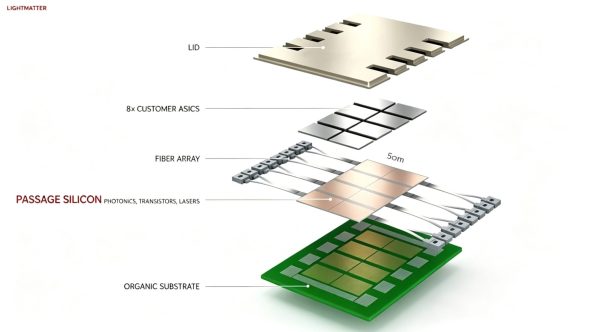
Compute and Switching Layer: This layer includes the switch ASIC, network processor, or AI accelerator. It handles packet forwarding, switching logic, data scheduling, and high-speed electrical interfaces.
Optoelectronic Conversion Layer: This layer includes EIC and PIC devices. The EIC provides electrical driving and control, while the PIC integrates waveguides, modulators, photodetectors, couplers, and other silicon photonic structures.
External Light Source Layer: Many commercial CPO approaches use external laser sources. Separating the laser from the optical engine can improve thermal management and simplify serviceability.
Passive Fiber Routing Layer: This layer includes FAU, fiber shuffle structures, PM fiber arrays, edge couplers, surface couplers, and other passive optical assemblies used for high-density optical routing.
Key Hardware Components in CPO Systems
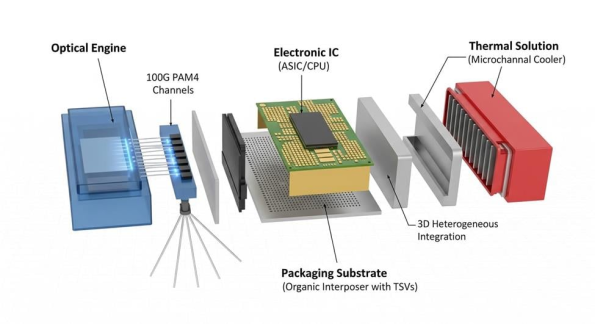
Switch ASIC or AI Accelerator: The main electronic chip responsible for switching, routing, or computing. It is the central device that CPO is designed to support.
Photonic Integrated Circuit (PIC): A silicon photonic chip that integrates optical waveguides, modulators, photodetectors, splitters, and coupling interfaces.
Electronic Integrated Circuit (EIC): A high-speed electronic chip that drives modulators, receives detector signals, and manages electrical interfaces between the ASIC and PIC.
Optical Engine: A compact assembly that combines photonic and electronic functions with fiber coupling structures. It is the core optical conversion unit in many CPO platforms.
External Laser Source (ELS): A laser source placed outside or away from the main package. It supplies continuous light to optical engines while reducing thermal stress near the ASIC.
Fiber Array Unit (FAU): A high-precision passive component that aligns multiple optical fibers to the waveguide interface of a PIC or optical engine.
PM Fiber Array: A polarization-maintaining fiber array used when stable polarization alignment is required, especially in systems involving silicon photonics and external laser coupling.
Fiber Shuffle Cable: A customized fiber routing assembly that rearranges fiber order between dense optical interfaces, helping match chip-side waveguide layouts to system-side fiber routing requirements.
CPO vs Pluggable Optics vs LPO
CPO is often discussed together with traditional pluggable optical modules and Linear Pluggable Optics (LPO). These technologies are not always direct replacements for each other. They serve different performance, cost, and maintenance requirements.
| Item | CPO | Pluggable Optics | LPO |
| Optical conversion location | Near ASIC or inside package | Front-panel module | Front-panel module |
| Electrical path | Very short | Longer PCB path | Longer than CPO |
| Power efficiency | High | Lower at very high speeds | Good, but signal margin is limited |
| Bandwidth density | Very high | Limited by front-panel space | Moderate to high |
| Maintainability | More complex | Excellent hot-swappable design | Good hot-swappable design |
| Best-fit applications | AI clusters, HPC, hyperscale switches | General data centers and broad deployments | Cost-sensitive short-reach applications |
Main Benefits of CPO
Lower Power Consumption: By shortening electrical paths and reducing reliance on high-power signal compensation, CPO can help lower interconnect power consumption in high-speed systems.
Higher Bandwidth Density: Because optical engines are integrated closer to the ASIC, CPO can support dense optical I/O without being fully constrained by front-panel module space.
Better Signal Integrity: Shorter high-speed electrical links reduce attenuation, reflection, and distortion, which helps maintain cleaner signals at high data rates.
Improved Thermal Architecture for Large Systems: Although CPO creates new thermal challenges, external laser source designs can isolate laser heat from sensitive photonic structures and improve serviceability.
Scalable Optical Routing: With FAU, fiber shuffle cables, and high-density fiber assemblies, CPO enables compact optical routing between chips, optical engines, and system-level fiber infrastructure.
Engineering Challenges of CPO
Thermal Management: CPO places optical engines close to high-power ASICs. Silicon photonic devices are sensitive to temperature variation, so careful thermal design is required.
Manufacturing Complexity: CPO requires precise integration of electronic chips, photonic chips, packaging substrates, couplers, and fiber arrays. Small alignment errors can affect insertion loss and channel uniformity.
Fiber Management: High-density CPO systems may require complex fiber routing. Bend radius control, channel identification, routing order, and mechanical protection are critical.
Maintainability: Traditional pluggable modules are easy to replace. CPO can improve performance but may increase repair and replacement complexity unless the design includes detachable optical or laser components.
Standardization: CPO interfaces, mechanical structures, thermal designs, and fiber routing formats are still evolving. This can create compatibility challenges across suppliers and platforms.
CPO Industry Ecosystem
The CPO ecosystem includes switch chip vendors, AI accelerator companies, silicon photonics suppliers, external laser source manufacturers, packaging foundries, fiber component manufacturers, and system integrators. Companies developing high-speed switches and AI networking platforms are exploring CPO as a path toward higher bandwidth density and lower power consumption.
At the component level, passive optical assemblies are essential. Even if the ASIC, EIC, and PIC define the electrical and photonic performance, the final system also depends on stable optical coupling, repeatable fiber alignment, low-loss routing, and reliable mechanical packaging. This is where FAU, PM fiber arrays, and fiber shuffle cables become important.
Fiber-Life CPO Fiber Array Solutions
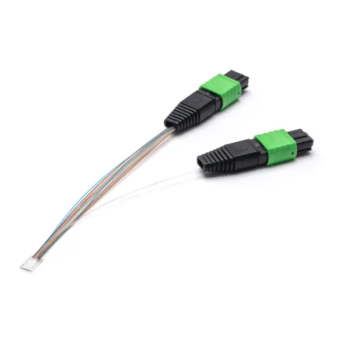
In CPO systems, optical coupling accuracy, fiber routing density, and polarization stability directly affect insertion loss, channel uniformity, and long-term reliability. Fiber-Life provides customized passive optical components designed to support high-density optical routing between silicon photonic chips, external laser sources, optical engines, and system-level fiber infrastructure.
High-Precision FAU for CPO Systems: Fiber Array Units provide accurate multi-channel fiber alignment for PIC edge coupling, optical engine interfaces, and compact photonic packages. Custom fiber count, pitch, fiber type, polishing angle, and housing structure can be configured according to the optical interface design.
Polarization Maintaining Fiber Array: PM fiber arrays help maintain stable polarization alignment in systems that require controlled optical polarization. They are suitable for external laser source coupling, silicon photonic interfaces, and polarization-sensitive optical architectures.
Fiber Shuffle Cable for Dense Optical Routing: Fiber shuffle cables reorganize fiber channel order in compact CPO packages. They help match non-uniform chip-side waveguide layouts with system-side fiber routing requirements, simplifying dense optical interconnection inside modules or switch platforms.
Fiber-Life supports customized fiber arrays for research, prototyping, and production-oriented optical interconnect applications. Available customization options may include fiber type, channel count, fiber pitch, connector type, fiber length, polishing angle, alignment structure, and packaging format.
Summary
Co-Packaged Optics is an important interconnect architecture for next-generation AI data centers and high-performance computing networks. By moving optical engines closer to switch ASICs or AI accelerators, CPO shortens electrical paths, improves bandwidth density, and supports more efficient high-speed data transmission.
However, CPO also introduces new engineering challenges, including thermal management, manufacturing complexity, fiber routing density, and standardization. Reliable passive optical components are therefore essential for practical deployment. FAU, PM fiber arrays, and fiber shuffle cables help provide the optical alignment, polarization stability, and dense routing required in modern CPO systems.
As AI clusters continue to demand higher bandwidth and lower power consumption, CPO is expected to become an increasingly important technology in advanced data center interconnect design.
Frequently Asked Questions
What is CPO in optical communication?
CPO, or Co-Packaged Optics, is an optical interconnect architecture that integrates optical engines close to electronic chips such as switch ASICs or AI accelerators. It reduces electrical path length and improves high-speed transmission efficiency.
How is CPO different from pluggable optical modules?
Pluggable optical modules are inserted into front-panel cages and are easy to replace. CPO places the optical engine much closer to the ASIC, which improves power efficiency and bandwidth density but increases packaging and maintenance complexity.
Why is CPO important for AI data centers?
AI data centers require massive data exchange between GPUs or accelerators. CPO helps reduce interconnect power consumption and supports higher bandwidth density, making it suitable for large-scale AI and high-performance computing networks.
Why do many CPO systems use external laser sources?
External laser sources can reduce thermal stress near the ASIC and optical engine. They also improve serviceability because the laser can be managed or replaced separately in some system designs.
What does FAU do in a CPO system?
FAU provides accurate multi-fiber alignment between optical fibers and photonic chip interfaces. It helps reduce coupling loss and maintain stable optical performance across multiple channels.
What is the role of a fiber shuffle cable in CPO?
A fiber shuffle cable rearranges fiber channel order in dense optical systems. It helps connect chip-side optical channel layouts to system-side fiber routing structures more efficiently.
Can CPO replace all pluggable optical modules?
CPO is mainly suitable for high-performance AI, HPC, and hyperscale switching systems. Pluggable modules will remain important for many general data center and telecom applications because they are flexible, standardized, and easy to maintain.